One system for the water-hygiene paper trail
UK legionella contractors run on evidence: temperatures taken, samples sent, remedials closed, and five years of records ready for whoever asks. BlueWave replaces the calendar, forms app, shared drive and spreadsheet that usually carry that burden. We designed and built the whole platform: office web app, offline engineer app, ops console and the infrastructure underneath.
Visit BlueWave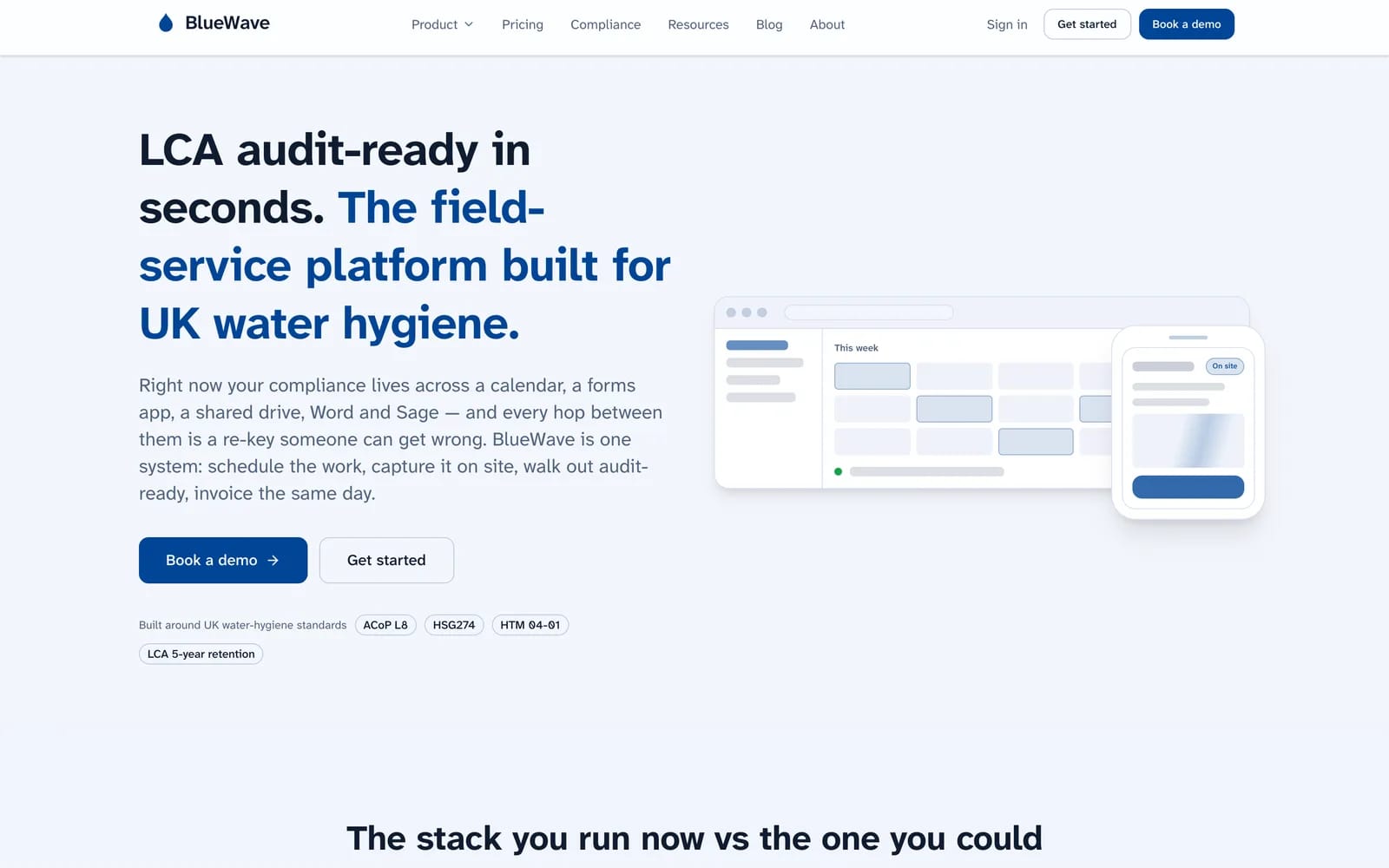
The market, and the problem worth solving
Legionella control is one of the most tightly evidenced trades in the UK. ACoP L8 and HSG274 set out what must be monitored and when, monitoring records must be kept for at least five years, and the Legionella Control Association audits its roughly 380 registered firms annually, with the assessor picking jobs at random and expecting the full evidence chain. When it goes wrong it ends up in court: one care operator was fined £3 million after a resident died, and a hospital trust was prosecuted after 114 positive legionella tests and 651 out-of-range temperature readings sat in its records without being acted on.
The strange part is the tooling. Most contractors are small firms running this obligation across a calendar, a forms app, a shared drive, Word and Sage, and every hop between those systems is a re-key someone can get wrong. The work gets done. Proving it was done, quickly, while an auditor watches, is the hard bit.
Scheduling has its own breaking point. A contractor with forty-odd sites on mixed monthly, weekly and quarterly frequencies is juggling thousands of dated visits a year, and a whiteboard stops coping long before that.
The brief was blunt: one system from booking the visit to producing the record, priced so a six-van contractor can afford it, and honest about what software can and cannot certify.
What we built
BlueWave covers the whole loop. Office staff plan recurring and reactive work on a drag-and-drop scheduler. Engineers capture evidence on site, with or without signal. The paperwork files itself into a five-year archive that can be searched the way an auditor asks questions.
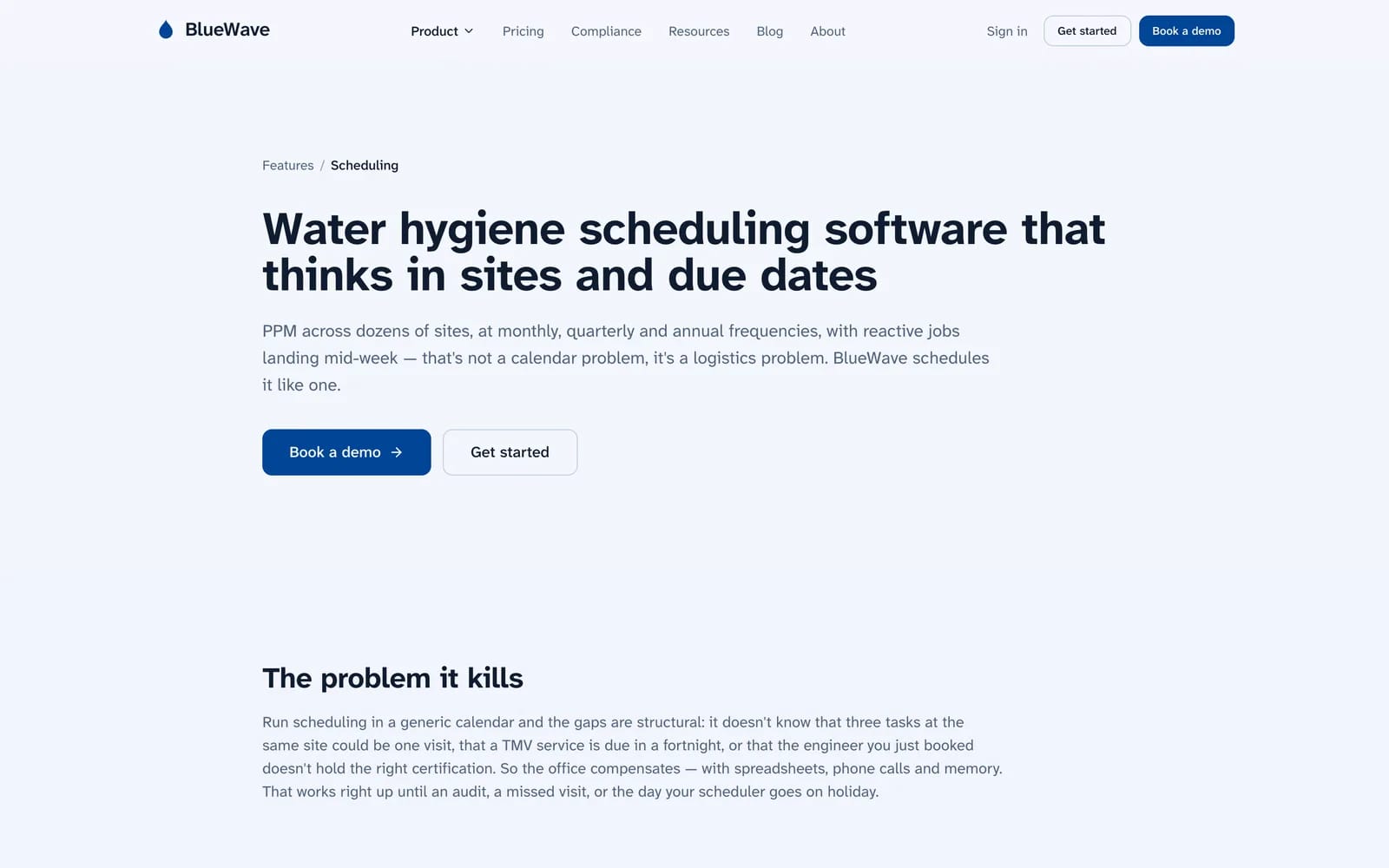
Scheduling built for PPM
Recurring visits with real-world rules, including 'third Tuesday' and 'last Friday' patterns. A run-sheet board for who does what today, and a timeline view for the week ahead. Moving one occurrence of a series never scrambles the rest.
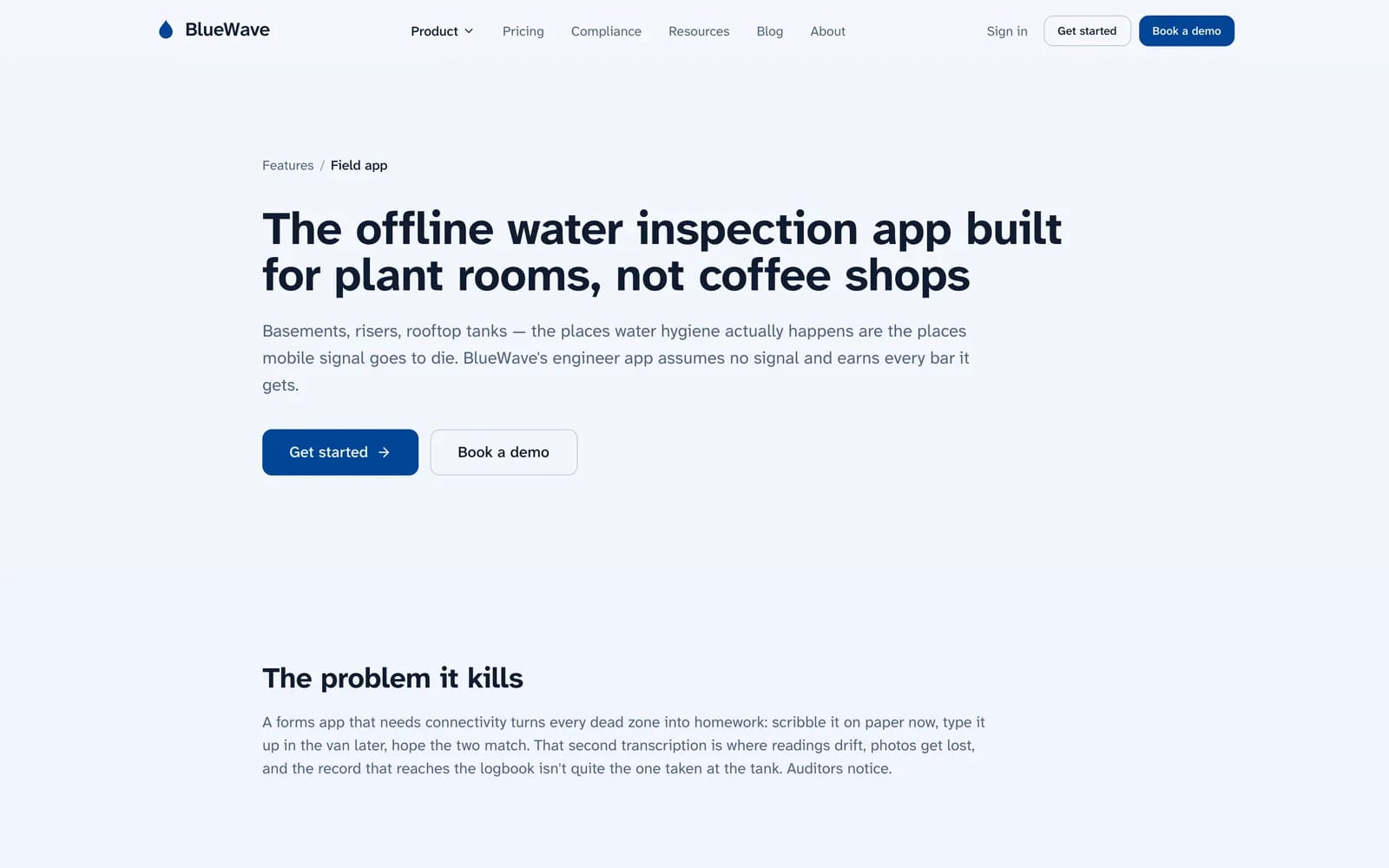
An engineer app that works in basements
Plant rooms rarely have signal, so the field app assumes none. Jobs, forms and photos are stored on the device and sync when the engineer surfaces. Logging out never deletes unsynced evidence, because tablets get handed around.
A form engine, not fixed forms
Eighteen field types, from signatures and photos to repeating asset groups. Templates are versioned, so a record always validates against the form it was filled in with, and out-of-range temperature readings are flagged the moment a form is submitted.
The library an auditor would design
Every submitted job sheet, filterable by customer, site, asset and date, with per-visit PDF export. Records are never hard deleted. Removing a document leaves an audit note saying who removed what, and when.
Lab results with an ageing clock
UKAS lab reports attach to the visit they belong to, and the morning briefing shows how long results have been waiting. A positive Legionella sample should never sit unread in an inbox over a bank holiday.
Quoting wired into the work
Quotes move through draft, sent, awaiting PO and invoiced, with itemised lines and PDF export. Platform subscriptions run on Stripe with Bacs Direct Debit, at per-seat prices a small contractor can actually pay.
Invoices machines can read
Every invoice the platform issues is a Factur-X e-invoice: an ordinary PDF carrying its own figures as structured XML inside, in the EN 16931 profile the European mandates recognise. Each document is validated against the official European rule set before it ships, and a failed check falls back to a plain PDF rather than a blocked download.
The engineering
Compliance software has one non-negotiable: the record must be defensible years later. Most of the interesting engineering here serves that single idea.
The audit trail is the product
Every entity writes to PostgreSQL as a JSONB document with an append-only sidecar of change deltas. Deleting a file orphans the blob rather than destroying it, and the audit note records who removed it. Job records snapshot customer and asset names at creation, so renaming a customer today cannot rewrite a two-year-old record.
Offline-first, done honestly
The engineer app keeps an event-sourced outbox in IndexedDB. Every mutation is an append-only event with a client timestamp, because compliance cares when the work was actually done, and its UUID doubles as an idempotency key so flaky connections cannot double-submit. iOS has no Background Sync, so syncing runs on foreground triggers instead of wishful thinking.
Recurrence without the classic bugs
Each visit pins an immutable occurrence date, the same trick iCalendar uses, alongside a movable scheduled date. That one decision kills the double-render bug that plagues recurring schedulers, and lets a cancelled slot be rebooked without inventing a new record.
A dual-store back end
PostgreSQL 17 is the write side and source of truth. Elasticsearch is the read side, feeding global search across customers, sites, assets, jobs and quotes. There is no ORM in between, and adding a field needs no migration.
Run like it matters
Twelve workloads on GKE in Google's London region, which keeps the data in the UK. Ten Pub/Sub event types, PDFs rendered by a headless-Chromium service, FusionAuth for identity, and more than a thousand automated tests behind it.
E-invoicing behind a validation gate
A stateless sidecar builds the EN 16931 invoice XML and refuses anything that fails the official CEN business rules, then the PDF service embeds it as PDF/A-3. Real output passes veraPDF, Germany's KoSIT validator and the European Commission's own checker with zero errors. If any step fails, the invoice still downloads as a plain PDF and the failure logs, because compliance tooling must never block an invoice.
AI with a job to do
Water hygiene is a documents trade, which makes it unusually good ground for AI. We designed the platform so models can land without re-architecture: every record is typed, versioned and audit-trailed, which is exactly what makes AI output reviewable rather than risky. This is the roadmap, in the order the economics support.
Read the legacy form library
Every new contractor arrives with a folder of PDF and Word forms built up over years. A vision model that maps those into BlueWave's typed form schema turns weeks of onboarding into a review pass, which is the commercial wedge in a market where setup fees are the norm. The strict schema means a wrong guess gets rejected, never silently stored.
Parse lab reports on arrival
Every sample already carries a globally unique reference. Document extraction over the incoming UKAS PDF, matched on that reference, lands results as structured readings and flags positives the hour they arrive instead of whenever someone opens the inbox.
Check evidence at the point of capture
Engineers photograph probe displays next to the number field they type into. OCR on that photo can verify the reading against the field's expected range on device, catching transposed digits while the engineer is still standing at the tank.
Answer the auditor's question directly
The archive is built for retrieval, and the next step is asking it questions in plain English. 'Show me every out-of-range hot-water reading at this site since 2024' should return cited records, and because every record carries provenance, the answer is defensible rather than plausible.
Shape, effort and money
This is a phased programme, not a one-off project. Compliance platforms earn trust release by release, and the commercial shape reflects that.
Indicative investment
£150k to £250k to first release
Field-service compliance platforms of this shape, a web app, an offline mobile app, scheduling and billing, typically reach first production release for £150,000 to £250,000 with a senior team of three to four. Grown over 18 to 24 months the cumulative programme usually lands between £400,000 and £520,000. Figures exclude VAT and third-party costs, at London rates as of mid-2026. That is the band for the shape, not an invoice.
Where it landed
BlueWave is live on Google Cloud's London region with an LCA-registered contractor running work through it as design partner, feeding back from real plant rooms rather than a demo script.
The honest measure of a compliance platform is whether the record holds up under someone else's scrutiny. Everything in this build, from append-only audit trails to versioned form templates, was shaped by that test.
Asked about this project
BlueWave is a field-service and compliance platform for UK water-hygiene and legionella-control contractors. It covers scheduling, offline evidence capture on site, five-year compliance records, lab results and quoting in one multi-tenant system, replacing the usual mix of calendar, forms app, shared drive and spreadsheets.
Ready to build the thing?
Book a free 30-minute call. We'll dig into your idea, your stack and your timeline, and give you an honest read on what it will take to build and launch. You'll leave with a clearer plan whether or not you hire us.