Music education platform for students and educators
We were engaged to build Treble, a music-theory exam practice platform with a studio where educators write lessons.
The market and the problem
A graded theory exam rewards practice, and practice needs somewhere to happen. We built Treble, the platform for working through a grade topic by topic: lessons with notation they can hear, short quizzes, mock exams across the whole grade and scores by topic. We also built the studio where educators can write and publish lessons and build the questions, and the billing that charges by the grade.
On the platform, every grade is organised into five areas: rhythm and pitch, scales and keys, intervals and chords, terms and signs, and questions that pull them together. A student improves by answering a great many questions, and by finding out which area is losing them marks.
Neither is something a printed paper does well. It cannot mark itself, and it cannot show which area is costing a student marks. That takes a platform that scores every answer and keeps the results by grade and by area.
The people who write the material should not need a developer, so the platform needed an authoring studio they could use without waiting for a release: lessons with real music notation in them, and questions that can carry pictures and more than one right answer.
The money side had to follow how students study. They take a grade at a time, add the next one part-way through a month, and sometimes drop one at renewal. Charging by the grade sounds simple until those cases arrive.
The brief was one platform for the whole path, from the first lesson to a mock exam, where educators publish lessons for themselves and billing runs itself.
What we built
We delivered one platform for two kinds of user. Students can work through a grade's lessons and tests and see their scores by topic. Educators have a studio of their own, where they can write lessons and build the questions. A lesson goes live when they publish it.
Lessons with notation that plays
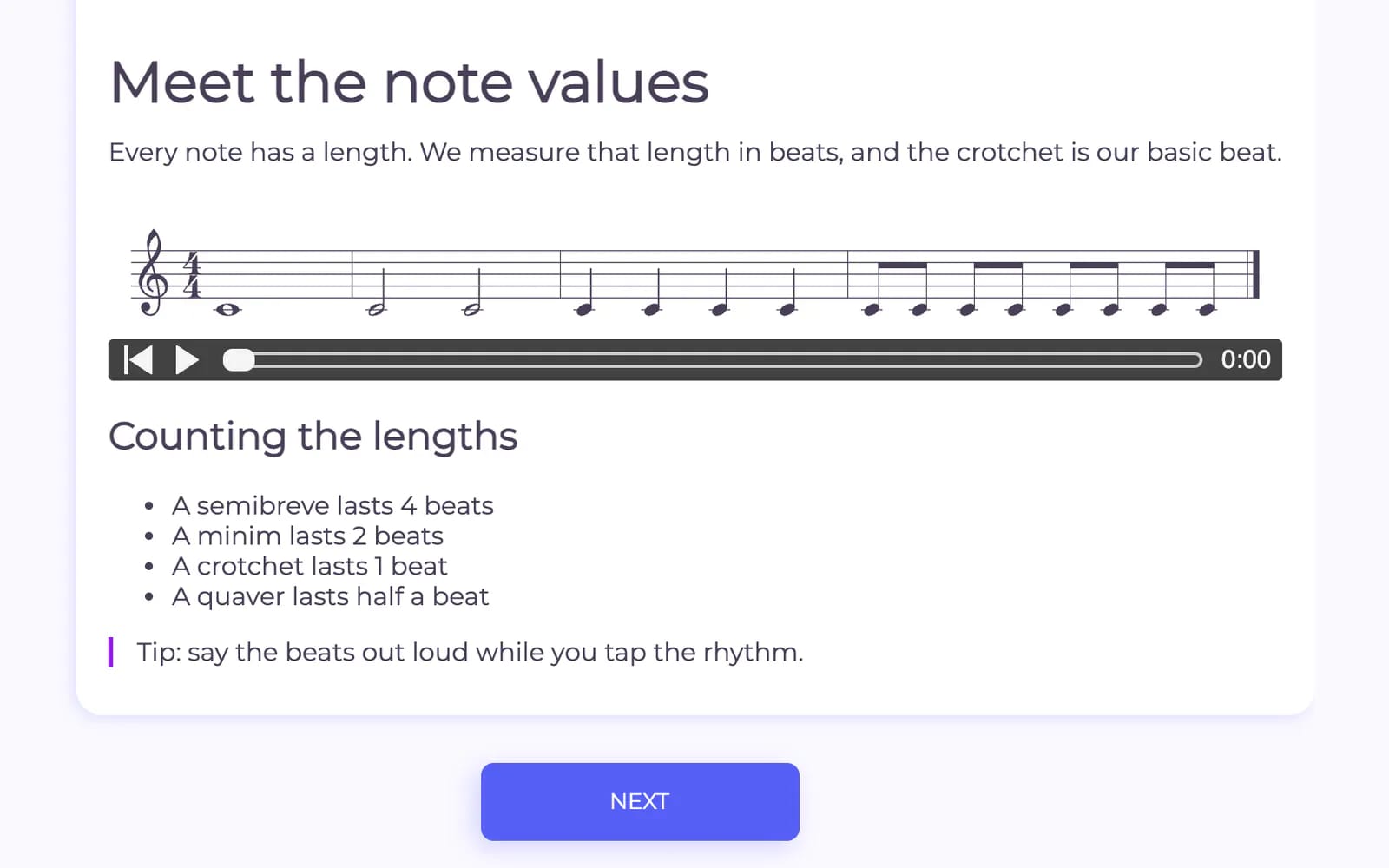
A lesson is rich text with real music in it. The stave is drawn in the page, and where the device supports audio a player under it plays the notes, with restart and a progress bar. The platform remembers each lesson a student has read, so it can say how much of a grade they have covered.
An authoring studio for educators
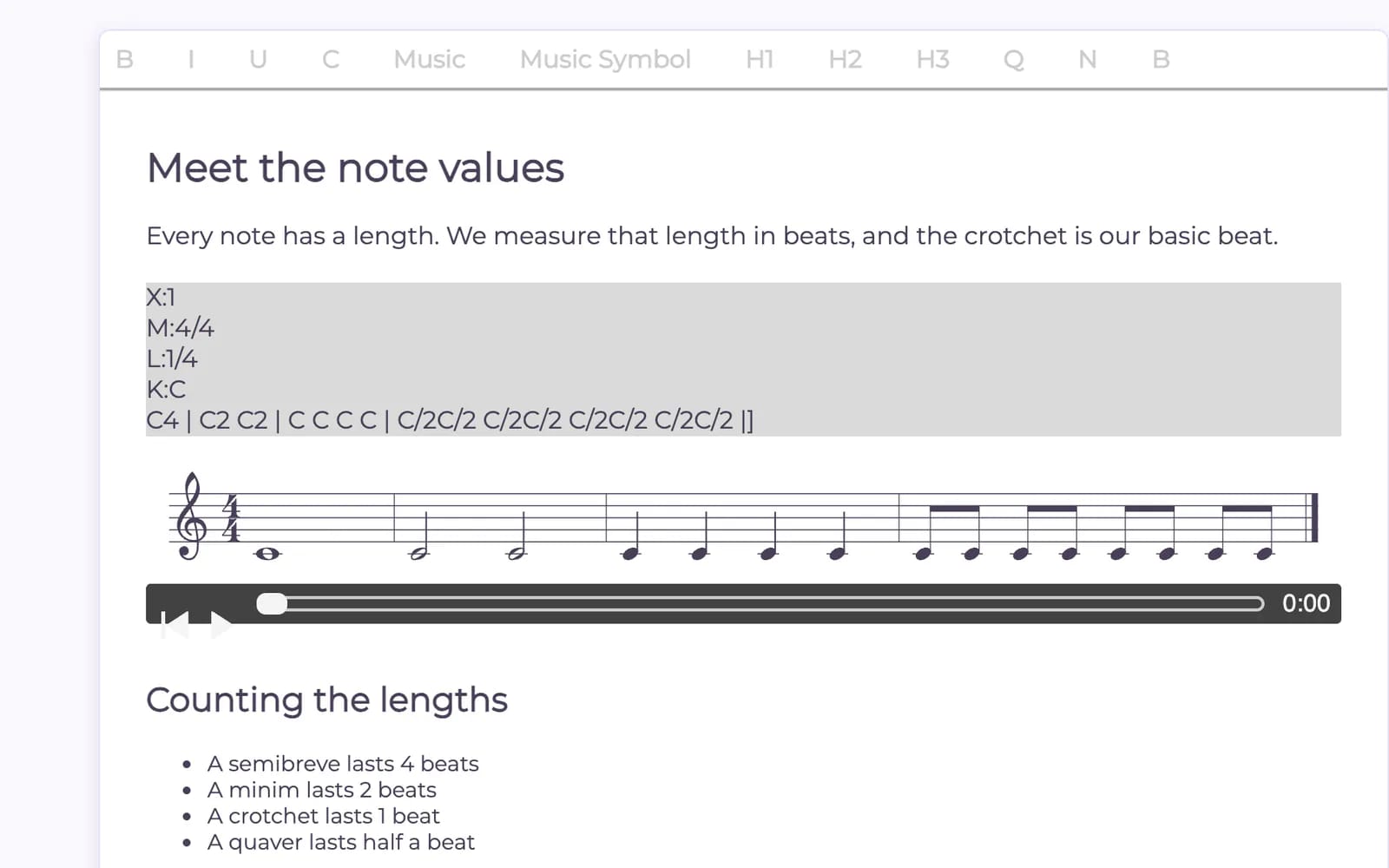
Educators choose a grade, an area and a topic and write the lesson in a rich-text editor. They type the music as plain text and see it drawn, and playable, in the preview. They preview the lesson as a student sees it, then publish or withdraw it. Lessons number themselves, and the question builder takes pictures, several correct answers and a check that every question has at least one right answer.
Quizzes and mock exams
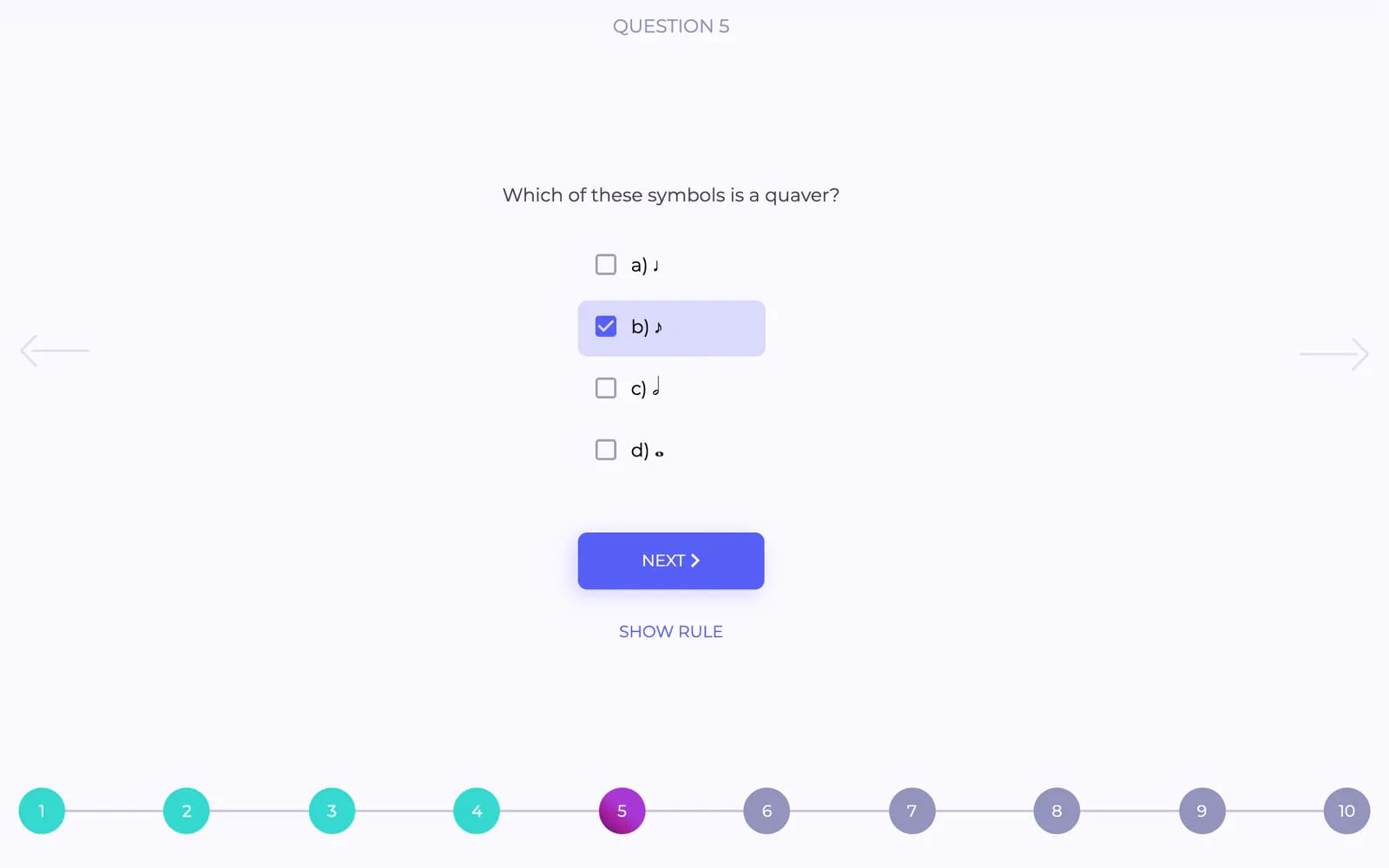
A quiz draws a short set of questions from one topic, with a rule to read if a student is stuck. A mock exam draws its questions from the whole grade. Students can move back and forth between questions, an unfinished test can be picked up again, and an abandoned one is scored out of the whole test, with unanswered questions counted as wrong.
Progress a student can read
The dashboard shows how much of each grade a student has learned and how many quizzes and exams they have completed, with the average score, for each grade and each area inside it. After a test, a review sets every question beside the right answer.
A free trial with no card
A new account can try up to three quizzes and five lesson views before paying, with no card needed. Mock exams need a subscription to the grade.
Subscriptions by the grade
Students pay for the grades they are studying and add one part-way through a month, paying only for the rest of it. They can cancel a single grade at renewal, change their mind before it lapses, manage their cards and retry a failed payment without contacting anyone.
The engineering
Students stop trusting a learning platform when a score changes after the fact or a charge is wrong, so most of the engineering here keeps those two honest. The decisions below do not depend on the tools it was built with.
Notation drawn and played from plain text
Educators add music to a lesson without a notation package or an image upload, and fixing a note is a text edit. A music block in the editor takes text in the ABC notation format. The browser engraves it as the lesson loads and, where the device allows audio, adds a player that has loaded its notes ahead of time. The library loads only in the browser, so pages rendered on the server are unaffected.
What happens to a score if an educator removes a question?
Nothing, which is what students and educators both expect. Each test keeps its own copy of every question and answer exactly as the student saw them, so a question removed later leaves every past result intact. The link back to the original is simply cleared.
Marking on the server
Students do not see the right answers until they finish, and everyone is marked by the same rule. The browser receives each question and its options, and the correct answers stay on the server until the test is complete. The server marks the test: a question with several right answers counts only when the student picks exactly the right set, and the score is the number right out of the number asked. The marking rules are covered by automated tests.
Billing that survives a change of mind
A student can change what they pay for at any point, and the account has to stay right. Each student has one Stripe subscription with a line for every grade. Adding a grade raises an invoice at once for the rest of the period. Cancelling one marks it, and when the next renewal invoice is drafted the platform credits the line and removes the grade. Card checks such as 3-D Secure, and declined cards, are handled in the app, and a failed payment appears for the student to retry.
Payment events handled off the web path
A slow payment event should never hold up a student's lesson. Each Stripe event is queued and a separate worker handles it. The worker asks Stripe for the current state, rebuilds the student's subscription summary and writes it to the account, so the account follows Stripe's records however the events arrive. The same worker also sends the email-confirmation messages.
Releases that run the tests first
A subscription product needs releases that are repeatable and dull. Automated tests run inside the build, so a failing test stops the release. Every build gets a version number and goes to a staging environment first, with the database migrations applied before the new code. Staging bills by the day, so a renewal or a cancellation can be tried in a day. One front-end build moves from staging to production with its settings supplied at run time, and production is a deliberate step. The cluster and database were deployed to Google Cloud's London region.
Phases, team and price
Delivery record
- Status
- Delivered
- Delivery
- Four phases
- Team
- Small senior team
- Releases
- Tests run in every build, staging before production
- Hosting
- Built for Google Cloud, London region
Case study published , updated .
The Treble engagement was delivered in phases, each adding what students or educators needed next. The band below is for a platform of this shape, and we publish bands for the other shapes we have built too.
Indicative price
£110k to £175k for this shape
A subscription learning platform of this shape, with a student web app, an authoring studio with playable notation, a marking engine and Stripe billing, typically runs £110,000 to £175,000 with a small senior team. We would expect school accounts, class rosters, assignments and teacher reporting, which this platform does not include, to take a build to about £180,000 to £300,000. Excludes VAT and third-party costs, at London rates as of mid-2026. Bands for the shape, not an invoice.
How we build
What every build goes through
These commitments hold on every build we run:
- Nothing is built until the specification is written down and you have agreed it.
- A senior engineer reviews every change before it is merged.
- Automated tests run on every change, and a failing build does not ship.
The delivery record shows this project's own details. How we work sets out the rest of the method.
What the engagement achieved
The platform was built with staging and production environments in Google Cloud's London region. The result for the client was one platform with lessons, quizzes, mock exams and subscriptions for students, and a studio where educators can write and publish lessons and build the questions.
The parts we would carry into another learning product are the ones that protect trust: marks kept on the server and a test history that removing a question cannot change. The billing logic carries over too, because it follows how students change their minds.
- Built for Grades 1 to 5 on one platform, from first lesson to mock exam
- Notation drawn and played from plain text, with no developer needed to add it to a lesson
- Marks computed on the server, with each test keeping its own copy of every question
- Subscriptions by the grade, with changes mid-month, cancellation at renewal and failed-payment retry
- Releases that run the tests inside the build, with a staging environment that bills by the day
The decision we would defend
Every test keeps its own copy of each question
When a student starts a quiz or exam, the platform copies the questions and answers into that test. An educator can remove a question later and no score moves. It stores more, and we would make the same call again, because a result that changes after the fact costs a student's trust and a table of copies costs very little.
Asked about this project
What is Treble?
We were engaged to build Treble as a subscription platform for students preparing for graded music-theory exams, Grades 1 to 5. It was built so that students could work through lessons with notation they can hear, quizzes and mock exams, and see their scores by topic, and so that educators could write and publish lessons and build the questions in an authoring studio. Other products share the name Treble; this study covers only the music-theory platform.
Who was the client for Treble?
We do not name a client without their agreement. This study names the platform only, and its screens show invented sample content.
Can teachers set work for a class on Treble?
No. The platform was built for individual students, with a studio where educators write the content. It has no class rosters, assignments, teacher reporting or school sign-in. By our estimate, adding them would take a build to about £180,000 to £300,000.
Does Treble use AI?
No. Lessons and questions are written in the authoring studio, a test draws its questions at random from the grade and topic, and the server marks answers by fixed rules. If you are adding AI to a learning product, settle what data it sees, how its output is checked and who signs it off before anything else.
What does a platform like Treble cost to build?
A subscription learning platform of this shape, with a student web app, an authoring studio with playable notation, a marking engine and Stripe billing, typically costs £110,000 to £175,000 from a small senior team, excluding VAT. We would expect school accounts, class rosters, assignments and teacher reporting, which this platform does not include, to take a build to about £180,000 to £300,000. A single-workflow product built to production standard typically costs £35,000 to £80,000 over 6 to 12 weeks.
Tell us what you're building or deciding.
Tell us about a product you want built, or a decision about AI you need to make, and we'll set up a 30-minute call. You'll get a straight answer on what it would take, including when the answer is that you don't need us.
What happens after you get in touch
We reply within one working day
By email, to arrange a time for the call.
A free 30-minute call
With a senior engineer, not a salesperson, about what you are building or deciding.
The fee in writing first
If a first step is worth taking, you get its exact fee in writing before any work starts.